


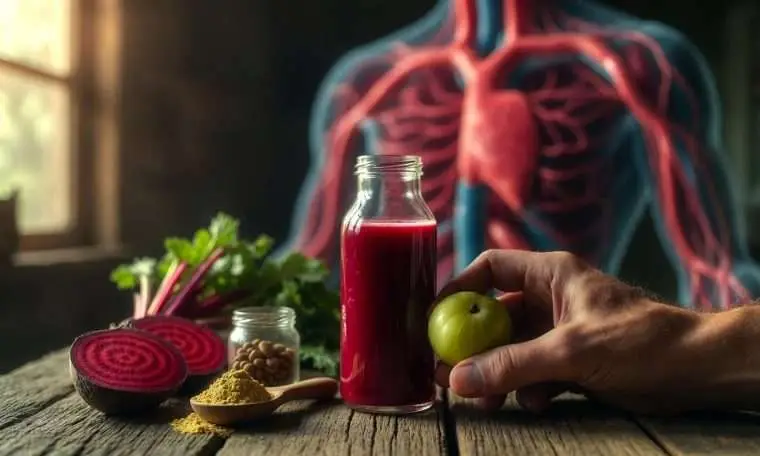
The hidden role of the endothelial lining, oxidative stress, and vascular damage in circulation and blood pressure health.
Millions of people are drinking beetroot juice, taking nitric oxide boosters, and chasing better circulation, yet many still struggle with high blood pressure, cold hands and feet, poor endurance, and vascular stiffness. What if the real problem is not simply a lack of nitric oxide, but damage to the delicate lining of the blood vessels themselves?
For the past several years, nitric oxide has become one of the hottest topics in the natural health world. People are drinking beetroot juice, taking L-arginine, citrulline, nitric oxide capsules, and testing themselves with saliva strips in hopes of improving circulation, endurance, energy, and blood pressure.
For some people, these approaches help substantially. For others, the improvements seem temporary or incomplete. Blood pressure may improve slightly for a while and then plateau. Hands and feet may still feel cold. Exercise recovery may remain poor. Energy levels fluctuate. Something still feels “off” in the system.
That raises an important question.
What if the problem is not simply a lack of nitric oxide itself? What if the deeper issue involves the condition of the blood vessels and the endothelial lining that controls nitric oxide production and signaling throughout the body? This is where the discussion becomes far more interesting.
The Endothelium: The Hidden Organ Most People Never Hear About
Inside every artery, vein, and capillary is an ultra-thin cellular lining known as the endothelium. Although it is only one cell thick, this lining plays a massive role in cardiovascular health.
The endothelium helps regulate:
- blood vessel dilation
- circulation efficiency
- inflammation
- blood clotting balance
- oxygen delivery
- nitric oxide production
- arterial flexibility
Healthy endothelial tissue produces nitric oxide naturally. Nitric oxide then signals the smooth muscles surrounding blood vessels to relax and expand. This allows blood to flow more freely and efficiently. When the endothelial lining becomes damaged over time, nitric oxide signaling can begin to break down. This may help explain why some people continue consuming nitric oxide boosters yet still struggle with circulation problems.
Oxidative Stress and the Destruction of Nitric Oxide
Nitric oxide is highly reactive and fragile inside the body. It can be rapidly destroyed by oxidative stress and inflammation.
Over decades, the endothelial lining may be exposed to:
- high blood sugar
- smoking
- chronic stress
- processed food intake
- environmental toxins
- inflammation
- oxidized LDL particles
- poor sleep
- sedentary living
As oxidative stress increases, nitric oxide availability may decline even if the body still has the raw materials needed to produce it. This is why some researchers and practitioners now believe that preserving nitric oxide may be just as important as producing it.
In simple terms, pouring more nitric oxide precursors into the system may not fully solve the problem if the vascular environment itself is damaged.
Why Beetroot Works for Some People
Beetroot remains one of the most popular natural circulation supports for a reason. Beets contain naturally occurring nitrates that the body can convert into nitric oxide through a multi-step process involving oral bacteria and vascular tissues.
Many people report improvements in:
- exercise endurance
- blood flow
- blood pressure
- energy
- muscle recovery
But beetroot mainly functions as a nitric oxide substrate supplier. It helps provide raw material for nitric oxide production. That does not necessarily address endothelial damage or oxidative destruction occurring within the blood vessels themselves. This may be one reason why some individuals eventually begin looking beyond nitric oxide boosters alone.
Enter Amla Fruit
Phyllanthus emblica, commonly known as amla or Indian gooseberry, has been used for centuries in traditional Ayurvedic practices. Unlike beetroot, amla appears to work more heavily through antioxidant and endothelial-support pathways.
Amla contains powerful plant compounds known as:
- emblicanin A
- emblicanin B
- gallic acid
- ellagic acid
- polyphenols
- tannins
These compounds are associated with strong antioxidant activity and may help reduce oxidative damage within the vascular system.
Researchers have studied amla for its potential effects on:
- endothelial function
- LDL oxidation
- arterial stiffness
- cholesterol balance
- inflammation
- blood sugar regulation
- vascular flexibility
One of the more interesting aspects of amla is that its antioxidant compounds may help preserve nitric oxide activity by reducing oxidative stress inside the blood vessels. This creates a very different mechanism compared to simply supplying more nitrate precursors.
The “Bucket with Holes” Analogy
A growing number of people experimenting with circulation support now describe nitric oxide production using a simple analogy. If the vascular system is damaged, inflamed, and oxidized, adding more nitric oxide precursors may be like pouring water into a bucket filled with holes. The body may produce nitric oxide, but the environment needed to preserve and utilize it efficiently may no longer function properly.
This is one reason why some people are now combining:
- beetroot
- nitric oxide support
- mitochondrial support
- antioxidant support
- endothelial support compounds like amla
rather than relying on a single approach.
Personal Observation and Experimentation
Recently, I came across an interesting personal testimony from a woman discussing blood pressure and circulation support. She explained that despite using common nitric oxide strategies, her blood pressure remained elevated. According to her account, the major improvement occurred only after she began using amla fruit supplements consistently.
While individual experiences should never be treated as universal proof, the underlying theory regarding endothelial support and oxidative stress aligns with several legitimate areas of cardiovascular research.
That prompted me to begin experimenting with amla powder personally.
I already use nitric oxide support approaches including beetroot and related circulation strategies. I also monitor nitric oxide trends periodically using saliva strips. After learning more about amla’s potential endothelial-support properties, I began adding a small amount of amla powder to water as part of a morning routine.
One interesting observation about amla is its extremely astringent taste. That puckering sensation likely reflects its high tannin and polyphenol content, including emblicanins. At this stage, I am approaching it as a long-term vascular support experiment rather than expecting overnight results.
Amla and Vascular Aging
One of the biggest overlooked factors in circulation health is simple vascular aging. Blood vessels are not static pipes. They are living tissues that respond to inflammation, oxidation, stress hormones, and nutrient status over decades.
As the endothelial lining deteriorates:
- arterial flexibility may decline
- nitric oxide signaling may weaken
- circulation efficiency may fall
- blood pressure may gradually rise
This may explain why some people can have “normal” cholesterol yet still struggle with vascular problems.
Healthy circulation depends on much more than cholesterol numbers alone.
Why All of this Really This Matters
The modern health industry often promotes single-solution thinking:
- one supplement
- one deficiency
- one pathway
- one miracle ingredient
Human physiology rarely works that way.
Circulation health involves:
- mitochondrial function
- antioxidant balance
- endothelial integrity
- inflammation control
- mineral balance
- nitric oxide signaling
- nervous system regulation
- metabolic health
Nitric oxide remains important, but perhaps the future of circulation support lies not only in increasing nitric oxide production, but also in restoring the environment in which nitric oxide can function properly.
That may be where compounds like amla become especially interesting.
My Final Thoughts
Amla fruit is not new. It has existed for centuries in traditional systems of health support. What is changing today is the growing scientific interest in how its compounds interact with endothelial function, oxidative stress, and vascular signaling.
For people already experimenting with nitric oxide support, beetroot, exercise, circulation supplements, and mitochondrial health strategies, amla may represent another piece of the puzzle worth exploring.
The real question may not simply be:
“How do we produce more nitric oxide?”
The deeper question may be:
“How do we restore the health of the blood vessels that nitric oxide depends on?”


